A ‘low maintenance’ garden, designed to be manageable

You want a garden you enjoy, not one that takes over your weekends. A manageable garden is designed from the start around the time you actually have, and it does not need to be plain or boring to do that.

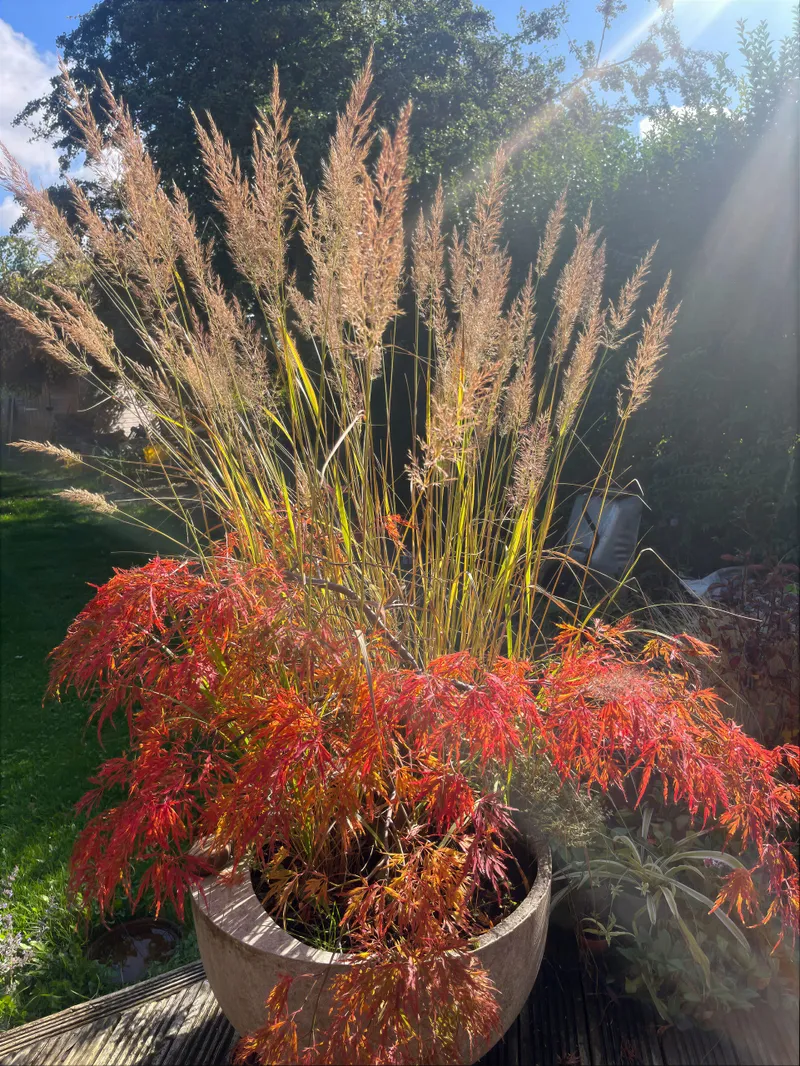
Ornamental grasses in warm autumn colour

The maintenance problem is usually a design problem

When people ask me for a garden that looks after itself, what they usually mean is a manageable one, and the difference matters to me. A garden that asks nothing of you tends to end up as plastic grass and a barbecue once a year, and that is not what I design. A manageable garden is designed around the time you actually have: plants chosen for your soil and conditions, ground cover that leaves weeds nowhere to start, surfaces that do not need constant attention, and borders sized to the hours you want to spend on them. I design manageable gardens across Yorkshire, on soils from Vale of York clay to Harrogate gritstone to Wetherby magnesian limestone.

Most gardens that feel like hard work were never designed to be otherwise. They were planted with beautiful things that suit a different climate, or a different soil, or a person with considerably more time. They grew, and became unmanageable, and the gap between the garden as imagined and the garden as experienced widened every season.

This is almost always fixable, but it has to be addressed at the design stage, not the afterthought stage.

If you are not sure whether your garden has tipped over into hard work, Is your garden a burden? has a simple way to find out. And if you need colour in a hurry while you decide, annual seed mixes will fill a gap for a season with very little effort from you.
What manageable design looks like

The right plants in the right place

Plants that suit their conditions require very little encouragement. They don't need constant feeding, staking, dividing, or replacing. They settle in, establish well, and get on with it. I spend a significant part of every consultation understanding your soil, your aspect, your shade pattern, and your local microclimate. The planting plan that follows is built on that, not on a wish list that looks lovely in a magazine but struggles in your particular corner of Yorkshire.

Ground cover that does the work for you

Bare soil is an open invitation to weeds. One of the most effective things I can do in any garden is design planting that covers the ground properly, using low-growing perennials, spreading ground cover species, and mulched areas that suppress growth and retain moisture. This sounds simple. It takes considered design to do well: the right density, the right species, the right relationship between plants. Done properly, it reduces maintenance significantly and makes the garden look more intentional rather than less.

Surfaces that age well and ask little

The materials in a garden (paths, terraces, edging, surfaces) have a significant impact on how much time you spend maintaining it. Some materials are beautiful but demanding. Others are equally handsome and require almost nothing. I always specify surfaces with long-term care in mind: materials that don't need annual sealing, edges that don't need constant redefining, paving that drains properly so moss and algae don't take hold. These choices are invisible when they work. Very visible when they don't.

A manageable garden is not about using gravel instead of planting, or replacing the lawn with decking. It is about making deliberate choices so that the time you do spend in the garden is enjoyable rather than exhausting.

Sally Tierney

What a manageable garden is not

It's not just gravel and raised beds. Gravel gardens and raised beds can be excellent choices, but they are not automatically manageable, and they are not the only options. A well-planted traditional border can be far less demanding than a poorly designed gravel scheme that becomes a weed nursery within a season.

It's not about removing everything interesting. The assumption that a manageable garden has to be sparse or plain is understandable, but wrong. Some of the most richly planted gardens I've designed are also among the least demanding. The key is species selection and structural design, not the absence of plants.

It's not a permanent solution if the soil isn't right. If the underlying conditions aren't addressed (drainage, pH, compaction) even the most carefully chosen plants will struggle. This is why I always start with the soil. Everything else follows from there.

You can see gardens I have actually designed on my portfolio page.

What clients say on Google

5 from 31 Google reviews

Independent reviews from people whose gardens I have designed.

  • Andrew Portera year ago
    Competent, conscientious and creative! An RHS employee advised us to use a member of the Society of Garden Designers…because anyone can call themselves a garden designer! Sally has a robust combination of qualifications, experience…and medals, which underpin delivery of a professional yet personal garden design service. Sally has written a book called The Garden Equation, which really resonated with me. Three foundation steps are needed to balance the equation! 1. Experience of the garden - what you want to have, or do, in your garden. 2. Physical conditions - work with nature! 3. Maintenance - tailor the plan to your timeframe! Working through these steps helped us work through our priorities and communicate our preferences. Sally’s objectivity provided us with invaluable insight and a new perspective. Sally’s knowledge and skills have enabled us to transform our space. The gardens were a space we worked in and walked through. Now our two front gardens feel connected, even though they are separated by a road. We feel that our home extends into two beautiful garden rooms, where design underpins purpose and effort is rewarded with enjoyment.
  • Frances Brock3 months ago
    Sally's work was recommended to me initially by a 2 new neighbours, but then we also saw a totally different garden she has designed and really loved the blend of plant knowledge with varied hard landscaping and creativity. Each garden with which she was involved was unique. Our patch was a real challenge for any gardener, having poor drainage, heavy clay, two mature trees just over our fence, and nothing but rough grass. Sally was encouraging, enthusiastic and also realistic. She showed flexibility in her approach, amended the planting as necessary and always communicating clearly and in a timely way. She listens carefully to her clients' needs, hopes and fantasies, and is pragmatic in her approach. She makes clear the various options available, right at the start, so you can commit financially to the level of her input you want with confidence. She's incredibly hardworking when actually creating the garden physically, preparing beds, laying turf sourcing, planting, and she's also very generous with her time and effort. We are thrilled with the transformation achieved in a relatively short time, and cannot recommend her highly enough.
  • Stephen Wilkinson5 months ago
    Excellent garden transformation - highly recommend! We're absolutely delighted with the work Sally has done for us. After extending our house, we lost part of our garden and wanted to make the most of the remaining space, but lacked both the time and knowledge to do it ourselves. Sally was recommended to us and she's been wonderful from start to finish. She presented us with thoughtful ideas and options, then took care of arranging all the work, making the whole process stress-free. The result is fantastic - the garden looks beautiful even now in winter, and we're excitedly looking forward to seeing it come alive in spring and summer. We couldn't be happier and would highly recommend Sally to anyone looking for a skilled and reliable garden designer.

Read all reviews on Google

Questions about manageable gardens

Which plants make a Yorkshire garden manageable?

The plants that make a garden manageable are tough, long-lived perennials and grasses matched to your soil, so they largely look after themselves. In Yorkshire I lean on hardy geraniums, salvias, sedum, euphorbias, and grasses like Stipa and Calamagrostis. The real secret is not a magic plant list, it is putting the right plant in the right place.

Which perennials give year-round interest without much work?

Look for perennials with a long season and good structure even as they fade: echinacea, sedum, perovskia, rudbeckia, and ornamental grasses that hold their shape right through winter. Underplanting with bulbs gives early colour before they get going. Chosen well, a handful of these carries the garden through most of the year with very little work.

Which plants cope with clay soil and still ask little of you?

In the heavy clay common around York, the most reliable plants are the ones that cope with winter wet and summer baking: hardy geraniums, astrantia, persicaria, sedum, and many ornamental grasses. Improving the soil with organic matter helps everything settle in. My soil health page goes into more detail.

Let's design a garden that works for the time you actually have

A consultation is the right starting point. We'll talk honestly about your time, your garden, and what's realistically achievable.

Book a garden consultation